
Biology is the study of living things and how they live, grow, reproduce, and interact with their environment. It deals with plants, animals, humans, microorganisms, and other living organisms.
When you study Biology, you learn about things you can see around you every day. For example, you may learn how a plant makes its food, how the human body gets energy from food, how animals adapt to their environment, and how characteristics are passed from parents to their children.
The Biology syllabus also covers the diversity, interdependence, and unity of life. It teaches you about the continuity of life through inheritance and evolution. It also helps you understand how biological knowledge can be used in everyday life, community health, the environment, and the economy.
So, when you see the term Area of Concentration for Biology, it refers to the important topics and areas you should pay attention to when studying Biology for the examination.
Why Biology Is Important in the JAMB UTME
Biology is an important subject for many candidates who want to study courses related to health, agriculture, biological sciences, education, and other areas.
For the JAMB UTME, you need to understand the topics in the Biology syllabus instead of reading random Biology topics from different books.
The best place to start is the syllabus because it shows the areas and objectives you are expected to study.
For example, the Biology syllabus contains topics such as living organisms, nutrition, transport, respiration, reproduction, ecology, heredity, variation, and evolution. It also gives objectives that explain what candidates should be able to understand or do after studying each topic.
Think about it this way. If you have limited time to study for JAMB, would you rather read every Biology topic you can find, or would you rather follow the topics listed in the syllabus?
I would advise you to follow the syllabus closely. It can help you arrange your reading and spend more time on the topics you need to understand.
This is why the JAMB Area of Concentration for Biology is useful when planning your Biology study.
JAMB Area of Concentration for Biology 2027/2028
The JAMB Area of Concentration for Biology covers different parts of Biology that candidates are expected to study. One major part is Variety of Organisms, while another is Form and Functions.
These areas contain many smaller topics. So, you should not just read the headings and stop there. You need to understand the topics under each area and what you are expected to know about them.
I will show you the topics below in simple terms.
Variety of Organisms
The first major Area of Concentration for Biology is Variety of Organisms. This section teaches you about living organisms, their characteristics, their level of organization, different groups of organisms, and how organisms adapt to their environment.
Living Organisms
You should study the characteristics of living organisms and understand the differences between living and non-living things.
You also need to study:
- Cell structure and functions of cell components
- Plant and animal cells
- Levels of organization in living organisms
- Cell
- Tissue
- Organ
- System
- Organism
For example, Euglena and Paramecium can be studied at the cellular level. Epithelial tissue and Hydra are given as examples under the tissue level, while an onion bulb is an example under the organ level.
You should be able to identify structures found in plant and animal cells. You should also understand what the different cell components do and know how to compare plant cells with animal cells.
Do not only memorize the names of cell parts. Try to understand their functions and the differences between plant and animal cells.
Groups of Living Organisms
Another important part of the JAMB Area of Concentration for Biology is the study of different groups of organisms.
The syllabus covers:
- Monera, such as bacteria and blue-green algae
- Protista, such as Amoeba, Euglena, and Paramecium
- Fungi, such as mushrooms and Rhizopus
- Plantae
- Animalia
Under plants, you will meet groups such as Thallophyta, Bryophyta, Pteridophyta and Spermatophyta. Examples include Spirogyra, mosses, ferns, cycads, conifers, maize and water leaf.
You are expected to understand their external features and characteristics. You should also study their life histories and how structural complexity increases among the organisms listed in the syllabus.
Invertebrates and Vertebrates
The animal section is also broad.
For invertebrates, you should study organisms from groups such as:
- Coelenterates
- Platyhelminthes
- Nematoda
- Annelida
- Arthropoda
- Mollusca
Examples given include Hydra, tapeworm, earthworm, mosquito, cockroach, housefly, bee, butterfly and snail.
You will also study vertebrates, including:
- Pisces
- Amphibia
- Reptilia
- Aves
- Mammalia
The syllabus expects you to understand the advancement of these animals and their economic importance.
Adaptation in Organisms
Have you ever wondered why birds have different types of beaks or why some animals have body features that help them survive?
That takes us to adaptation.
You should understand structural, functional and behavioural adaptations. You also need to study adaptive colouration and behavioural adaptations in social animals.
The syllabus gives examples such as countershading in fish, toads and snakes. It also covers warning colouration, different castes in social insects such as termites, basking in lizards, hibernation and aestivation.
You should also understand adaptations connected with obtaining food, protection, securing mates, regulating body temperature and conserving water.
Adaptation is not a topic you should only memorize. Ask yourself how a particular feature helps an organism survive in its environment.
Form and Functions
The second major section in the JAMB Area of Concentration for Biology 2027/2028 is Form and Functions.
This part covers how different structures in plants and animals work. It includes internal structures, nutrition, transport, respiration, excretion, support and movement, reproduction, growth, coordination and control, and homeostasis.
Internal Structure of Plants and Mammals
You should study the internal structure of a flowering plant, including the:
- Root
- Stem
- Leaf
You need to know how to identify transverse sections of these organs and connect their structures with their functions.
The syllabus also covers supporting tissues in plants, including collenchyma, sclerenchyma, xylem and phloem fibres.
For mammals, you should understand the arrangement of internal organs and be able to describe the appearance and position of digestive, reproductive and excretory organs.
Nutrition
Nutrition is another large topic in the Biology syllabus.
You should study autotrophic and heterotrophic nutrition and know the differences between them.
The syllabus also includes plant nutrition, especially:
- Photosynthesis
- Mineral requirements
- Macro-nutrients
- Micro-nutrients
You should understand the light and dark reactions and the conditions needed for photosynthesis. You should also know why light, carbon (IV) oxide and chlorophyll are needed.
The syllabus expects you to understand mineral elements required by plants and recognise deficiency symptoms connected with nitrogen, phosphorus and potassium.
Animal nutrition is also included. You should study carbohydrates, proteins, fats and oils, vitamins, mineral salts and water.
Food tests are part of this area too. You should understand tests involving substances such as starch, reducing sugar, protein, oil and fat.
The mammalian tooth and alimentary canal are also listed. You need to understand the structure, types and functions of mammalian teeth, as well as digestion, absorption and assimilation of food.
Transport and Respiration
Transportation is another important Area of Concentration for Biology.
You should understand why plants and animals need transport systems and the materials that are transported.
For mammals, study the circulatory system, including the:
- Heart
- Arteries
- Veins
- Capillaries
You should also know the functions of important blood vessels such as the hepatic portal vein, pulmonary vein, pulmonary artery, aorta, renal artery and renal vein.
For plants, study xylem and phloem and understand their functions.
You should also learn about blood, lymph, diffusion, osmosis, plasmolysis and turgidity.
Respiration covers respiratory organs and surfaces, gaseous exchange, aerobic respiration and anaerobic respiration.
You should understand the importance of respiration and the role of oxygen in releasing energy for the activities of living organisms. The syllabus also expects you to know about fermentation using yeast cells and sugar solution.
Excretion, Support and Movement
Under excretion, study structures such as the contractile vacuole, flame cell, nephridium, Malpighian tubule, kidney, stoma and lenticel.
You should understand the excretory functions of the kidneys, lungs and skin. Plant excretory products are also included.
Support and movement covers movement in plants, supporting tissues in animals and the skeleton.
You should study exoskeleton and endoskeleton and understand the functions of the skeleton. The syllabus also expects you to know about different types of joints and how plant responses are connected with light, water, gravity and touch.
Reproduction and Growth
Reproduction covers both asexual and sexual reproduction.
For asexual reproduction, examples include fission in Paramecium, budding in yeast, natural vegetative propagation and artificial vegetative propagation.
You should also study sexual reproduction in flowering plants. This includes floral parts, pollination, fertilization and the products of sexual reproduction.
In mammals, you should understand male and female reproductive organs, fertilization and development.
Growth is also listed. You need to know the meaning of growth, germination of seeds and the conditions needed for germination. You should also understand epigeal and hypogeal germination.
Coordination, Control and Homeostasis
The Biology syllabus also covers nervous coordination.
You should study the central nervous system, peripheral nervous system, transmission of impulses and reflex action.
Sense organs are included too. These are the:
- Skin
- Nose
- Tongue
- Eye
- Ear
You should connect each sense organ with its function.
Hormonal control is another part of this topic. You need to study endocrine glands such as the pituitary, thyroid, parathyroid, adrenal gland, pancreas and gonads.
Plant hormones are also included. Examples given in the syllabus are auxins, gibberellin, cytokinin and ethylene. You should understand their effects on growth, tropism, flowering, fruit ripening and leaf abscission.
Finally, you should study homeostasis, especially body temperature regulation and salt and water regulation.
So, Variety of Organisms and Form and Functions cover a large part of the JAMB Biology syllabus. Read each topic together with its objective because the objective tells you what you should be able to do after studying the topic.
Biology Area of Concentration: Ecology
Ecology is another major part of the JAMB Area of Concentration for Biology 2027/2028. It focuses on how living organisms interact with one another and with their environment.
When you study Ecology, you are learning about things such as temperature, rainfall, soil, food chains, habitats, population, competition, pollution and conservation.
Do not treat Ecology as a topic you can skip. The syllabus contains several areas under Ecology, so you should study each one carefully.
Factors Affecting the Distribution of Organisms
The first part of Ecology deals with the factors that affect where organisms can live.
These factors are grouped into abiotic and biotic factors.
Abiotic Factors
Abiotic factors are non-living conditions in the environment.
The Biology syllabus expects you to study the effects of factors such as:
- Temperature
- Rainfall
- Relative humidity
- Wind speed and direction
- Altitude
- Salinity
- Turbidity
- pH
- Soil conditions
You should understand how these factors can affect the distribution of organisms.
For example, an organism that needs a particular temperature may not survive well in an environment that is too hot or too cold.
The syllabus also mentions the use of equipment such as a thermometer, rain gauge and Secchi disc to measure abiotic factors.
So, when studying this topic, don’t just memorize the names of the factors. Ask yourself: How can each factor affect where an organism lives?
Biotic Factors
Biotic factors are connected with living organisms.
The activities of plants and animals, especially human activities, can affect the distribution of organisms.
For example, when people change a natural habitat, the organisms living there may also be affected.
You should understand how the activities of living things can change the environment and affect the organisms found in it.
Symbiotic Interactions and Energy Flow
Another important part of the Area of Concentration for Biology is the relationship between organisms.
Relationships Between Organisms
The syllabus includes several types of relationships. These include:
- Symbiosis
- Parasitism
- Saprophytism
- Commensalism
- Mutualism
- Amensalism
- Competition
- Predation
- Cooperation
You should be able to give appropriate examples of these relationships and understand how they affect organisms.
You should also connect the distribution of organisms with food chains and food webs in particular habitats.
Think of a simple food chain. One organism gets energy by feeding on another organism, and that energy continues through the chain.
A food web is more complex because several food chains can be connected.
Make sure you understand the difference between a food chain and a food web.
Nutrient Cycling
The Biology syllabus also includes nutrient cycles in nature.
You should study:
- Carbon cycle
- Water cycle
- Nitrogen cycle
The carbon cycle includes the balance of atmospheric oxygen and carbon (IV) oxide and its connection with global warming.
The water cycle is also important because it affects other nutrient cycles.
For the nitrogen cycle, you should understand the roles of bacteria and leguminous plants.
Natural Habitats and Nigerian Biomes
Ecology also covers natural habitats and local Nigerian biomes.
Aquatic and Terrestrial Habitats
Aquatic habitats include places such as:
- Ponds
- Streams
- Lakes
- Seashores
- Mangrove swamps
Terrestrial and arboreal habitats include places such as tree-tops of oil palm, abandoned farmland, dry grassy savanna fields, and burrows or holes.
You should be able to associate plants and animals with these habitats and relate their adaptive features to the habitats where they live.
Local Nigerian Biomes
The syllabus specifically includes local Nigerian biomes.
These are:
- Tropical rainforest
- Guinea savanna
- Sudan savanna
- Desert
- Highlands of montane forests and grasslands of Obudu, Jos and Mambilla Plateau
You should know where these biomes are located and understand their features.
This part is especially useful because the syllabus expects you to connect the features of these biomes with different regions of Nigeria.
Population, Competition and Ecological Succession
Population ecology is another area you should study carefully.
Population Density and Competition
You should understand population density and overcrowding.
The syllabus expects candidates to understand why human population can change rapidly and the effects of overcrowding.
You should also know how to calculate population density as the number of organisms per unit area.
Competition is also included.
You should study:
- Factors that cause competition
- Intra-specific competition
- Inter-specific competition
- The relationship between competition and succession
- Niche differentiation
A simple way to remember the two types is this: intra-specific competition occurs among organisms of the same species, while inter-specific competition occurs between different species.
Factors Affecting Population Size
Population size can be affected by both biotic and abiotic factors.
Biotic factors listed in the syllabus include food, pests, disease, predation, competition and reproductive ability.
Abiotic factors include temperature, space, light, rainfall, topography, pressure and pH.
You should also understand how these factors can work together.
For example, a shortage of water can lead to food shortage. Lack of space can also contribute to an increase in disease rates.
Ecological Succession
Ecological succession is another topic under the JAMB Area of Concentration for Biology.
You should study:
- Primary succession
- Secondary succession
You should understand the sequence of changes that can take place until a stable climax stage is reached in a plant population.
Soil and Soil Fertility
Soil is another important part of the Biology Ecology section.
Types and Properties of Soil
The syllabus covers three major soil types:
- Sandy soil
- Loamy soil
- Clayey soil
You should study their characteristics, including:
- Soil structure
- Porosity
- Capillarity
- Humus content
- Soil organisms
- Soil air
- Soil water
You should also understand the inorganic and organic components of soil.
The syllabus expects you to identify the physical properties of different soil types using simple measurements such as particle size, porosity and water retention.
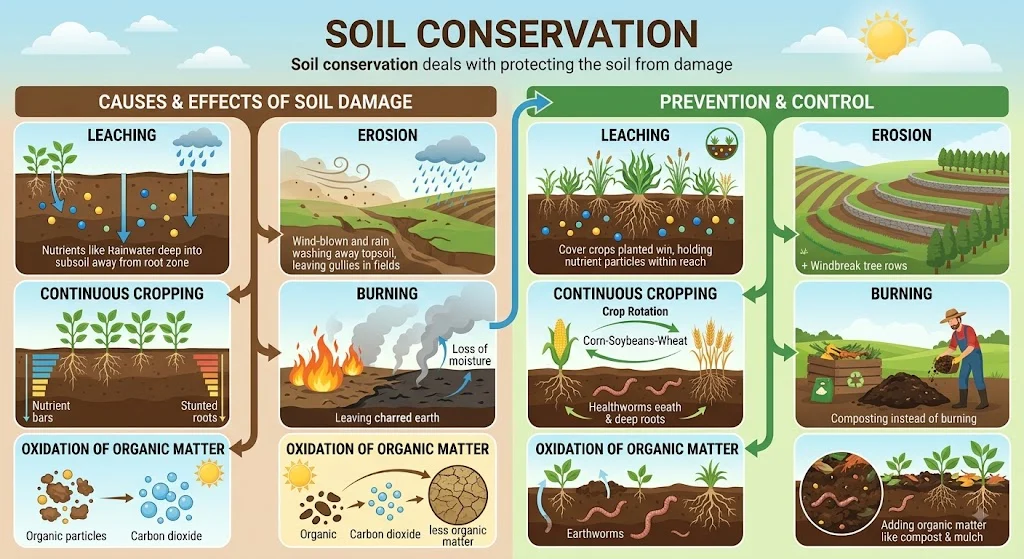
Loss and Renewal of Soil Fertility
You should also learn what can cause soil fertility to decrease.
The syllabus includes:
- Loss of inorganic matter
- Compaction
- Leaching
- Erosion of topsoil
- Repeated cropping with one variety
It also includes ways of maintaining soil fertility and conserving soil.
These include:
- Contour ridging
- Terracing
- Mulching
- Poly-cropping
- Strip-cropping
- Organic and inorganic fertilizers
- Crop rotation
- Shifting cultivation
When studying this topic, try to connect each farming practice with the problem it helps to reduce.
Humans and the Environment
The final major part of the Ecology section deals with humans and their environment.
Diseases
The syllabus includes common and endemic diseases as well as easily transmissible diseases and disease syndromes.
Examples listed include:
- Poliomyelitis
- Cholera
- Tuberculosis
- Gonorrhea
- Syphilis
- AIDS
The syllabus also mentions diseases such as malaria, meningitis, dracunculiasis, schistosomiasis, onchocerciasis and typhoid fever.
You should understand the ecological conditions that encourage the spread of diseases. You should also study the organisms or agents responsible, their modes of transmission, symptoms, prevention, treatment and control as stated in the syllabus.
The principles of inoculation and vaccination are also included.
Pollution and Conservation
Pollution is another important topic.
You should study:
- Air pollution
- Water pollution
- Soil pollution
- Sources of pollution
- Effects of pollution
- Methods of pollution control
Sanitation and sewage are also included. The syllabus expects you to understand the importance of solid waste disposal, sewage disposal, community health and personal hygiene.
You should also study the conservation of natural resources.
The syllabus includes game reserves and national parks and asks candidates to know their locations and importance in Nigeria.
So, when you are looking at the JAMB Area of Concentration for Biology, Ecology should receive serious attention. It covers organisms, habitats, populations, soil, diseases, pollution and conservation.
Biology Area of Concentration: Heredity and Variations
Heredity and variations are important parts of the JAMB Area of Concentration for Biology 2027/2028. This section teaches you why individuals of the same species can have different features and how some characteristics are passed from parents to their offspring.
When you study this section, you will meet topics such as variation, blood groups, chromosomes, inheritance, probability in genetics, sex determination and sex-linked characters.
The main idea is simple: organisms can show differences, and some characteristics can be inherited from parents.
Variation in Population
Variation means the differences that can be seen among individuals of the same population.
For example, people of the same age group may have different heights or weights. People can also have different fingerprints, eye colours, hair colours and blood groups.
The Biology syllabus groups variation into morphological and physiological variation.
Morphological Variation
Morphological variation refers to differences in physical appearance.
The syllabus includes differences in:
- Size, such as height and weight
- Colour, such as skin, eye, hair and animal coat colour
- Fingerprints
- Scales and feathers in animals
You should understand how these differences can occur among individuals.
The syllabus also expects candidates to be able to measure the heights and weights of pupils in the same age group and plot graphs showing the frequency distribution of the measurements.
So, don’t only memorize the meaning of morphological variation. Try to understand it using simple examples from people, plants and animals around you.
Physiological Variation
Physiological variation involves differences in how the bodies of individuals function.
The syllabus gives examples such as:
- Ability to roll the tongue
- Ability to taste phenylthiocarbamide (PTC)
- Blood groups
You should be able to identify examples of physiological variation and group people according to these differences.
Uses of Variation
Variation is not only something you learn for an examination. It also has practical uses.
Blood Groups and Paternity
The syllabus includes the application of discontinuous variation in blood transfusion and determination of paternity.
You should understand how knowledge of blood groups can be applied in these areas. The syllabus also connects heredity with marriage counselling, particularly in relation to blood grouping, sickle-cell anaemia and Rhesus factors.
Pay attention to the difference between continuous and discontinuous variation. The syllabus expects you to be able to differentiate between them and give examples.
Fingerprints and Crime Detection
Fingerprints are another example of variation.
You should understand how fingerprints can be classified and how knowledge of fingerprints can be applied in identity detection and crime detection.
This is a good example of how Biology can be connected to everyday life. A Biology topic that looks simple in your textbook can have practical uses outside the classroom.
Heredity and Chromosomes
Heredity is the passing of characters from parents to their offspring.
This is one of the major topics under the JAMB Area of Concentration for Biology.
The syllabus requires you to study heritable and non-heritable characters and understand the role of chromosomes in heredity.
Heritable and Non-Heritable Characters
A heritable character is a character that can be passed from parents to offspring.
A non-heritable character is not passed from parents to offspring in the same way. Environmental conditions can also affect some characteristics.
The syllabus expects you to determine heritable and non-heritable characters using examples.
When studying this topic, ask yourself: Is this characteristic connected to heredity, or can it be strongly affected by the environment?
That question can help you understand the difference instead of simply memorizing definitions.
Chromosomes and DNA
Chromosomes are included in the Biology syllabus as the basis of heredity.
You should study their structure and understand how hereditary characters are transmitted from parents to offspring.
The syllabus also expects candidates to illustrate the simple structure of DNA.
You should also understand how genes are separated during meiosis and how genes are recombined during fertilization.
Do not study chromosomes and genes as isolated words. Try to understand how they are connected to the inheritance of characters.
Probability in Genetics and Sex Determination
Another important topic in the JAMB Area of Concentration for Biology 2027/2028 is probability in genetics.
The syllabus expects candidates to analyze data from cross-breeding experiments and understand the way genes are passed from parents to offspring.
Genetic Crosses
You should understand that segregation of genes occurs during gamete formation and that recombination of genes occurs during fertilization.
The syllabus also expects you to understand that recombination of genes at fertilization is random.
When you see a genetics question, take your time. Identify the parents, the characters being considered and the possible offspring before trying to find the answer.
Sex Determination
Sex determination is also part of this section.
You should understand how sex is determined genetically and how the inheritance of characters can be studied through genetic crosses.
The syllabus also includes sex-linked characters.
Examples listed are:
- Baldness
- Haemophilia
- Colour blindness
You should be able to identify characters that are sex-linked.
Applications of Heredity
The knowledge of heredity can be used in several areas.
The Biology syllabus specifically includes its application in agriculture and medicine.
Heredity in Agriculture
You should understand how the principles of heredity can be used to produce new varieties of crops and livestock through cross-breeding.
The syllabus also asks candidates to understand the advantages and disadvantages of out-breeding and in-breeding.
This means you should not only know what cross-breeding means. You should understand why farmers and breeders may use these methods.
Heredity in Medicine
The syllabus also connects heredity with medicine.
It includes topics such as sickle-cell anaemia, blood grouping and Rhesus factors. It also asks candidates to examine the significance of recombinant DNA materials in producing medical products such as insulin, interferon and enzymes.
The syllabus also mentions genetically modified organisms, gene therapy and biosafety as areas for elementary analysis.
So, when studying Heredity and Variations, focus on understanding how differences occur, how characters are inherited, and how genetic knowledge can be used in agriculture and medicine.
This section may look difficult at first, especially when you reach genetic crosses and probability. But don’t rush. Start with the basic terms, understand how inheritance works, and then move to the calculations and applications.
Biology Area of Concentration: Evolution
Evolution is the final major section in the JAMB Area of Concentration for Biology 2027/2028. This section deals with how organisms have changed over a long period of time and the evidence used to support the idea of organic evolution.
The Biology syllabus places two main areas under Evolution:
- Theories of evolution
- Evidence of evolution
You should understand the main ideas behind evolution instead of only trying to memorize names and definitions.
Theories of Evolution
The syllabus includes three theories or ideas that you should study.
Lamarck’s Theory
The first is Lamarck’s theory of evolution.
You should know the contribution of Jean-Baptiste Lamarck to the study of evolution and understand his place in the development of ideas about how organisms change.
The syllabus expects candidates to examine the contributions of Lamarck and Charles Darwin to the theory of evolution.
When studying this topic, pay attention to the main ideas associated with each theory and how they attempted to explain changes in organisms over time.
Darwin’s Theory
The second major theory listed is Darwin’s theory of evolution.
The syllabus expects you to understand the contribution of Darwin to evolutionary theory. You should also understand organic evolution as the total of adaptive changes that have taken place over a long period and have contributed to the diversity of forms, structures and functions among organisms.
So, when reading Darwin’s theory, try to connect it with the diversity you see among living organisms.
For example, organisms living in different environments may have different features that help them survive in those environments.
Organic Theory
The Biology syllabus also lists organic theory under the theories of evolution.
You should study this topic together with Lamarck’s and Darwin’s theories so that you can understand the different ideas included in this section of the syllabus.
Do not ignore a topic simply because it looks short in the syllabus. A short heading can still require you to understand several ideas.
Evidence of Evolution
The second major part of the Evolution section is evidence that supports organic evolution.
The syllabus lists several types of evidence that you should know.
Fossil Records
Fossil records are one of the examples given in the Biology syllabus.
You should understand how fossils can provide evidence about organisms that existed in the past.
Fossils can help scientists study changes in organisms over long periods.
When studying this topic, focus on the relationship between fossil records and the history of life.
Comparative Anatomy, Physiology and Embryology
The syllabus also includes:
- Comparative anatomy
- Comparative physiology
- Comparative embryology
You should understand how comparing organisms can provide evidence for evolutionary relationships.
For example, when studying comparative anatomy, you may compare structures found in different organisms and consider their similarities and differences.
Comparative physiology looks at similarities and differences in how organisms function.
Comparative embryology involves comparing developmental stages in organisms.
Try to understand what each type of evidence tells us. Don’t just memorize the three names.
Evolutionary Trends in Plants and Animals
The syllabus also expects candidates to trace evolutionary trends in plants and animals.
This means you should study how changes in organisms can be traced over time.
Earlier sections of the Biology syllabus also introduce the advancement and evolution of different groups of plants and animals. For example, candidates are expected to trace the evolution of listed plants and understand the advancement of invertebrate and multicellular animals.
So, you should connect the Evolution section with the earlier Variety of Organisms section.
This is one reason why I advise you not to study each Biology topic as if it has nothing to do with the others.
Modern Evidence for Evolution
The Biology syllabus also mentions genetic studies and mutation as evidence connected with modern evolutionary theories.
You should understand the basic role of genetic studies and mutation in explaining changes in organisms.
This topic connects naturally with the Heredity and Variations section. When you study heredity, you learn about chromosomes, DNA, genes and the transmission of characters. When you study Evolution, you also meet genetic studies and mutation as part of modern evolutionary ideas.
So, pay attention to the connection between heredity, variation and evolution.
If you understand these links, Biology becomes easier to organize in your mind.
The main Evolution topics in the JAMB Area of Concentration for Biology are therefore:
| Area | What to Study |
|---|---|
| Theories of evolution | Lamarck’s theory, Darwin’s theory and organic theory |
| Evidence of evolution | Fossil records, comparative anatomy, physiology and embryology |
| Evolutionary trends | Trends in plants and animals |
| Modern evolutionary evidence | Genetic studies and mutation |
These are directly listed under the Evolution section of the Biology syllabus.
If you are making your Biology reading timetable, give yourself enough time to understand Evolution and its connection with Heredity and Variations.
Important Biology Topics You Should Study
The JAMB Area of Concentration for Biology 2027/2028 contains many topics. So, it is helpful to arrange them into smaller parts when planning your reading.
You should not only read the names of the topics. The Biology syllabus also gives objectives that show what you should be able to understand, identify, compare, explain or apply.
Major Topics to Pay Attention To
The Biology syllabus is divided into five main sections:
- Variety of Organisms
- Form and Functions
- Ecology
- Heredity and Variations
- Evolution
These five sections make up the main structure of the Biology syllabus.
Variety of Organisms
Under Variety of Organisms, you should study living organisms, cell structure and functions, levels of organization, groups of plants and animals, and adaptation.
You should also study the examples of organisms listed in the syllabus. These include bacteria, Amoeba, Euglena, Paramecium, fungi, plants, invertebrates and vertebrates.
Don’t just memorize the names. Learn the features that help you identify each organism and understand how the organisms are grouped.
Form and Functions
Form and Functions is a wide section.
It includes internal structures of plants and mammals, nutrition, transport, respiration, excretion, support and movement, reproduction, growth, coordination and control, and homeostasis.
This means you should give enough study time to topics such as photosynthesis, food tests, digestion, circulation, respiration, reproduction, nervous coordination and hormones.
How the Syllabus Objectives Can Guide Your Reading
One useful part of the Biology syllabus is the objectives written beside the topics.
The objectives tell you what you are expected to do after studying a topic. For example, under living organisms, the syllabus expects candidates to differentiate between living and non-living things and identify structures of plant and animal cells.
This gives you a simple way to study.
Read the Topic and Then Check the Objective
Suppose you are studying photosynthesis.
Don’t stop after reading the definition of photosynthesis. The syllabus says you should be able to differentiate the light and dark reactions and state the conditions needed for photosynthesis. It also expects you to understand the need for light, carbon (IV) oxide and chlorophyll and detect starch in a leaf as evidence of photosynthesis.
So, you can turn these objectives into questions for yourself.
Ask:
- What is photosynthesis?
- What are the conditions needed for photosynthesis?
- What is the role of light?
- What is the role of carbon (IV) oxide?
- What is the role of chlorophyll?
- How can starch be detected in a leaf?
This makes your reading more focused because you know exactly what you should understand.
Use the Objectives to Test Yourself
You can also use the syllabus objectives after reading a topic.
For example, after studying transport, ask yourself whether you can explain why organisms need transport systems, identify the organs involved, explain the functions of xylem and phloem, and describe diffusion, osmosis, plasmolysis and turgidity. These are areas included in the Biology objectives.
If you cannot explain something in simple words, go back to your textbook and study it again.
Ecology Topics You Should Not Ignore
Ecology contains several topics, so you should give attention to all the areas listed in the syllabus.
Important Ecology Areas
These include:
- Factors affecting the distribution of organisms
- Symbiotic interactions
- Food chains and food webs
- Carbon, water and nitrogen cycles
- Natural habitats
- Nigerian biomes
- Population density
- Competition
- Ecological succession
- Soil
- Soil fertility
- Diseases
- Pollution
- Conservation
- Game reserves and national parks
These topics are included under the Ecology section of the syllabus.
When reading Ecology, try to connect the topics with things you see around you.
For example, when you study soil, think about the type of soil found in your area and how farmers use it. When you study pollution, think about how poor waste disposal can affect water, soil and human health.
The easier it is for you to connect a topic with real life, the easier it can be to remember what you have studied.
Heredity and Evolution Topics
You should also give proper attention to Heredity and Variations and Evolution.
Heredity and Variations
Study:
- Continuous and discontinuous variation
- Morphological variation
- Physiological variation
- Blood groups
- Fingerprints
- Heritable and non-heritable characters
- Chromosomes
- DNA
- Gene transmission
- Probability in genetics
- Sex determination
- Sex-linked characters
- Cross-breeding
- Out-breeding
- In-breeding
- Applications of heredity in agriculture and medicine
The syllabus also mentions genetically modified organisms, gene therapy and biosafety.
Evolution
For Evolution, study:
- Lamarck’s theory
- Darwin’s theory
- Organic theory
- Fossil records
- Comparative anatomy
- Comparative physiology
- Comparative embryology
- Evolutionary trends in plants and animals
- Genetic studies
- Mutation
These are the areas listed under Evolution in the syllabus.
When you study Evolution, remember that it connects with variation and heredity. This can help you understand why these sections appear as different parts of the same Biology syllabus.
Make a Simple Biology Reading Plan
You do not need to study everything in one day.
You can divide the Area of Concentration for Biology into smaller study sessions.
For example, you could spend one study session on cell structure, another on nutrition, another on transport, and another on Ecology.
After studying a topic, review what you have learned and test yourself using questions.
You can also write short explanations in your own words. If you cannot explain a topic simply, it may mean that you need to study it again.
I will always advise you to understand the Biology syllabus first, then use your Biology textbook to explain the topics in greater detail.
The syllabus should help you know what to study, while your textbook can help you understand the topics better.
JAMB Recommended Biology Textbooks
The Biology syllabus also contains a list of recommended Biology textbooks. These books can help you understand the topics in the JAMB Area of Concentration for Biology in more detail.
You do not have to read every Biology book available. A better approach is to use the syllabus as your guide and then use a suitable textbook to explain the topics you need to study.
Recommended Biology Books
The following Biology textbooks are listed in the syllabus:
| Author | Recommended Textbook |
|---|---|
| Ndu, F.O. C. Ndu, Abun A. and Aina J.O. | Senior Secondary School Biology: Books 1-3; Longman, Lagos |
| Odunfa, S.A. | Essential of Biology; Heinemann, Ibadan |
| Ogunniyi M.B., Adebisi A.A. and Okojie J.A. | Biology for Senior Secondary Schools: Books 1-3; Macmillan |
| Ramalingam, S.T. | Modern Biology, SS Science Series; New Edition, AFP |
| Stan. | Biology for Senior Secondary Schools; Revised Edition, Heinemann, Ibadan |
| Stone R.H. and Cozens, A.B.C. | Biology for West African Schools; Longman |
| Usua, E.J. | Handbook of Practical Biology, 2nd Edition; University Press Limited |
These are the recommended texts listed at the end of the Biology syllabus.
Read also: Full List of JAMB Recommended Textbooks for Biology 2027/2028
How to Use the Textbooks With the Syllabus
A textbook can give you more explanations, examples and illustrations than the syllabus itself.
Start With the Syllabus
Before opening your Biology textbook, look at the topic you want to study in the syllabus.
For example, if you want to study nutrition, check the Biology syllabus first. You will see areas such as autotrophic and heterotrophic nutrition, photosynthesis, mineral requirements, classes of food, food tests, teeth and the alimentary canal.
Then open your textbook and study those areas.
This can help you avoid spending too much time reading Biology topics that are not part of the syllabus.
Use More Than Just Definitions
When reading a textbook, don’t stop after memorizing definitions.
Look at diagrams, examples and explanations. Try to understand how structures work and how different Biology topics connect.
For example, when studying the mammalian circulatory system, you should understand the heart, arteries, veins and capillaries and also know the functions of important blood vessels listed in the syllabus.
You can then test yourself without looking at the book.
Ask yourself: Can I explain this topic to another student using simple words?
If your answer is yes, you are making good progress.
Why Practical Biology Should Not Be Ignored
One of the recommended books is Handbook of Practical Biology by Usua, E.J.
This is worth noticing because the Biology syllabus includes objectives that involve practical activities and observations.
For example, candidates may be expected to understand food tests, detect starch in a leaf, measure population density, study soil properties and use equipment to measure environmental factors.
So, when studying Biology, don’t focus only on reading notes. Pay attention to practical examples and how Biology experiments are carried out.
The recommended textbooks can support your study, but your main guide should remain the Biology syllabus.
Use the syllabus to know what to study, and use your textbook to understand the topic better.
Frequently Asked Questions About JAMB Biology
Is There a JAMB Area of Concentration for Biology 2027/2028?
The Biology syllabus provides the topics and objectives candidates should study for the Biology examination. It is organised into five major sections: Variety of Organisms, Form and Functions, Ecology, Heredity and Variations, and Evolution.
So, when looking for the JAMB Area of Concentration for Biology, you should use these syllabus areas as your main study guide.
It is also important to study the objectives under each topic because they explain what candidates should be able to do after studying the topic.
What Topics Are in the Biology Area of Concentration?
The Biology syllabus contains many topics.
Under Variety of Organisms, you will study living organisms, cells, levels of organization, plants, animals and adaptation.
Under Form and Functions, you will study internal structures, nutrition, transport, respiration, excretion, support and movement, reproduction, growth, coordination and control, and homeostasis.
Ecology covers habitats, environmental factors, food chains, nutrient cycles, population, soil, diseases, pollution and conservation.
Heredity and Variations covers variation, chromosomes, DNA, inheritance, genetics, sex determination and sex-linked characters. Evolution covers theories of evolution and evidence of evolution.
Which Biology Topics Should I Study First?
There is no special order given in the syllabus that says you must study one topic before another.
However, you can make your reading easier by starting with basic topics such as living organisms, cell structure and functions, before moving to more detailed topics.
You can then study areas such as nutrition, transport, respiration, reproduction, Ecology, heredity and Evolution.
The important thing is to cover the syllabus instead of studying only the topics you personally like.
The objectives can also help you know what to focus on under each topic. For example, the syllabus does not only list photosynthesis; it also states that candidates should understand the conditions needed for photosynthesis and the role of light, carbon (IV) oxide and chlorophyll.
Are Recommended Biology Textbooks Useful for JAMB?
Yes. The Biology syllabus includes recommended textbooks that can help you study the listed topics in greater detail.
The recommended books include Senior Secondary School Biology, Essential of Biology, Biology for Senior Secondary Schools, Modern Biology, Biology for West African Schools and Handbook of Practical Biology.
But remember this simple rule:
Use the syllabus to know what to study, and use your textbook to understand what you are studying.
You can also use diagrams, examples and practical activities in your textbook to improve your understanding.
Can I Use the Biology Syllabus to Plan My Reading?
Yes. The syllabus can help you create a simple reading plan.
You can divide the five major sections into smaller study sessions. For example, you could study cells and living organisms first, then move to nutrition and transport, followed by Ecology, Heredity and Variations, and Evolution.
You should also include revision time.
After studying a topic, ask yourself questions from the objectives. If you cannot explain the topic in simple words, go back to your notes or textbook and study it again.
This approach can help you make better use of your study time because you are following the areas listed in the Biology syllabus rather than reading without a clear direction.
Conclusion
Final Advice for Biology Candidates
The JAMB Area of Concentration for Biology 2027/2028 covers a wide range of Biology topics. The five main sections are Variety of Organisms, Form and Functions, Ecology, Heredity and Variations, and Evolution.
So, don’t limit your reading to only one or two topics.
Start with the Biology syllabus and study each section carefully. Pay attention to the objectives under each topic because they show the knowledge and skills you are expected to have.
For example, under Ecology, you should understand environmental factors, habitats, population, soil, diseases, pollution and conservation. Under Heredity and Variations, you should study variation, chromosomes, DNA, inheritance, genetics and sex-linked characters.
I will advise you to make a simple reading timetable and cover the topics little by little. Don’t wait until the examination is close before you start revising everything.
You should also practise explaining Biology topics in your own words. When you understand a topic, it becomes easier to remember and answer questions about it.
Encouragement to Share and Comment
The JAMB Area of Concentration for Biology can give you a clear direction for your Biology study. But remember that reading the topic names alone is not enough. You need to understand the topics and the objectives listed in the syllabus.
Use the recommended Biology textbooks to learn more about the topics, and keep the syllabus beside you as you study. The syllabus includes recommended books such as Senior Secondary School Biology, Essential of Biology, Biology for Senior Secondary Schools, Modern Biology and Biology for West African Schools.
If this JAMB Area of Concentration for Biology 2027/2028 guide has helped you, share it with another JAMB candidate who may need it.
Do you have a Biology topic you find difficult? Tell me in the comment section. Your question may also help another student who is preparing for the same examination.