
Are you looking for the JAMB Area of Concentration for Agriculture 2027/2028? You are in the right place. I will show you the main Agriculture topics you need to study from the official syllabus provided for the examination.
The JAMB Area of Concentration for Agriculture covers five main areas: General Agriculture, Agronomy, Animal Production, Agricultural Economics and Extension, and Agricultural Technology. These areas contain the topics and objectives that guide what you should learn in Agriculture.
You will learn topics such as soil, crops, farm animals, animal nutrition, farm management, agricultural marketing, farm tools, machinery, biotechnology, and agricultural statistics. The syllabus also includes practical knowledge such as crop production, animal management, soil conservation, pest control, and the use of farm machines.
I will break the Agriculture syllabus into simple sections so you can know what to read and where to start. You will also see the important objectives attached to each topic. This can help you study with a clear plan instead of reading Agriculture topics randomly.
So, let us begin with the Area of Concentration for Agriculture 2027/2028.
Section A: General Agriculture
The first part of the JAMB Area of Concentration for Agriculture is General Agriculture. This section introduces you to the basic ideas of Agriculture, how Agriculture supports the economy, the environment where farming takes place, genetics, farm inputs, and agricultural development in West Africa.
1. Meaning and Scope of Agriculture
You should first understand what Agriculture means in modern terms. Agriculture is not only about planting crops or keeping animals. The syllabus expects you to understand Agriculture in relation to production, processing, and marketing.
You should also study the different branches of Agriculture. The syllabus specifically expects you to be able to differentiate between the various branches.
Another important area is the types of Agriculture. You should know the difference between subsistence Agriculture and commercial Agriculture.
Ask yourself: What makes subsistence farming different from commercial farming? What is the main purpose of each type?
Read Also: Agric JAMB Syllabus 2026/2027 Download PDF
2. Importance of Agriculture
Agriculture plays an important role in economic development. You should know how Agriculture helps individuals, industries, and communities.
Some of the areas listed in the syllabus include:
- Provision of raw materials for agro-allied industries
- Provision of employment
- Development of rural areas
You should be able to connect agricultural products with the industries that use them as raw materials.
3. Agricultural Ecology
Agricultural ecology is another topic under General Agriculture. Here, you need to study the ecological zones of West Africa and the agricultural products associated with each zone.
You should also understand environmental factors that affect crop and livestock production.
The syllabus expects you to differentiate between abiotic and biotic factors affecting Agriculture.
A simple way to approach this topic is to ask: What environmental conditions can affect a farmer’s crops or animals? Then think about how those conditions can influence production.
4. Genetics
Genetics is an important part of the Agriculture syllabus. You should study the first and second laws of Mendel, cell division, and basic genetic terms.
Some terms listed in the syllabus include:
- Locus
- Alleles
- Genotype
- Dominance
You should also be ready to apply Mendel’s laws to genetic crosses. The syllabus expects you to determine the outcome of crosses involving homozygous and heterozygous traits and compute simple probability ratios.
Don’t just memorize the names of genetic terms. Learn what each term means and how it is used.
5. Farm Inputs
You should also study farm inputs and their uses. The syllabus gives examples such as planting materials and agrochemicals.
Try to understand why farmers need different inputs and what each input is used for. You should be able to classify different types of farm inputs according to their uses.
6. History of Agricultural Development in West Africa
This topic covers how Agriculture has developed in West Africa. You should study different agricultural systems, including shifting cultivation and bush fallowing.
You should also know some of the problems affecting agricultural development, such as:
- Land tenure systems
- Inadequate infrastructure
- Finance for Agriculture
- Pollution
The syllabus also mentions national and international agricultural research institutes and agricultural development programmes. Examples include NCRI, IAR, IAR&T, CRIN, NIFOR, FRIN, RRI, NRCRI, NIHORT, LCRI, IITA, ILRI, ICRISAT, and WARDA.
You should know why these research institutes were established and how they have contributed to agricultural development.
7. Roles of Government and NGOs in Agricultural Development
The final topic in General Agriculture focuses on the roles of government and NGOs.
You should study how government policies can affect Agriculture. The syllabus includes areas such as import duties, import bans, agricultural laws, subsidies, credit facilities, and infrastructure.
The Land Use Act is also listed under agricultural laws and reforms.
You should understand how government can support farmers through transport systems, communication systems, credit facilities, and other forms of support. You should also study the contribution of NGOs to agricultural development.
The main idea is simple: learn what the government does, why it does it, and how those actions can affect farmers and agricultural production.
What You Should Focus on in General Agriculture
When studying this first section, don’t read only the topic names. Pay attention to the objectives under each topic because they tell you what you are expected to understand.
For example, you may need to differentiate, classify, apply, compute, identify, compare, or evaluate something. These words show the kind of knowledge you should develop.
Section B: Agronomy
The second part of the JAMB Area of Concentration for Agriculture is Agronomy. This section covers soil, crops, weeds, diseases, pests, pastures, forests, and crop improvement. It is one of the largest sections in the Agriculture syllabus, so I will break it down into simple topics.
1. Rocks and Soil Formation
You should begin with the basic ideas about rocks and soil formation. Study the factors that affect rock weathering and soil formation.
You should also understand the physical properties of soil, especially:
- Soil profile
- Soil texture
- Soil structure
A soil profile has different horizons. You should be able to identify and differentiate these horizons.
Soil texture is also important because soil contains different components. The syllabus expects you to be able to identify these components and compute the proportion of soil constituents.
You should also study the chemical properties of soil, including soil acidity and alkalinity and chemical components such as silicate.
Make sure you understand soil pH and how it can be determined.
2. Soil Water and Soil Conservation
Water is very important for plant growth, so you need to understand how water behaves in the soil.
The syllabus includes:
- Importance of soil water
- Sources of soil water
- Movement of soil water
- Management of soil water
- Conservation of soil water
You should know the difference between capillary water, gravitational water, and hygroscopic water.
You should also study water-holding capacity, wilting point, and plant-available and unavailable water.
Soil Conservation
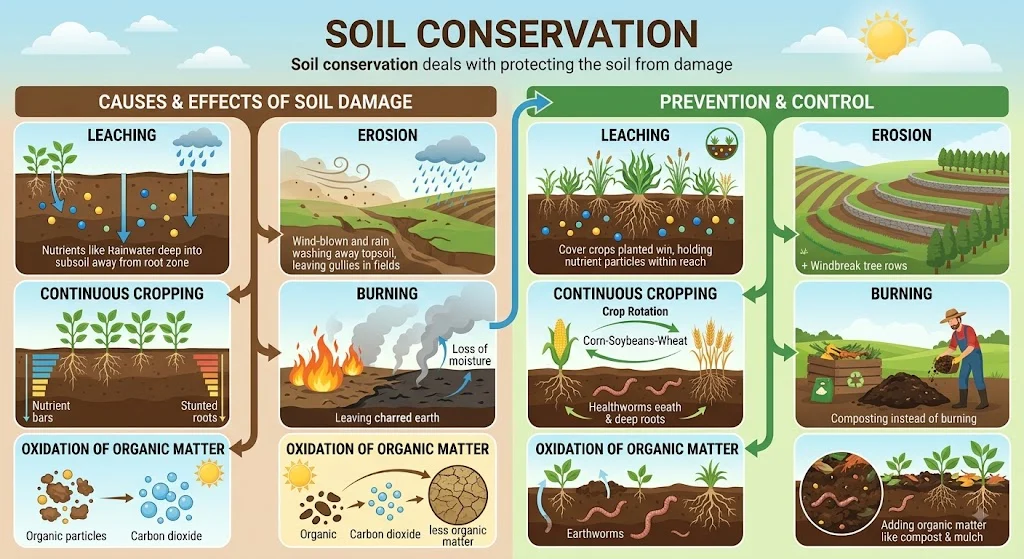
Soil conservation deals with protecting the soil from damage.
You should study the causes, effects, prevention, and control of:
- Leaching
- Erosion
- Continuous cropping
- Burning
- Oxidation of organic matter
The syllabus also includes irrigation and drainage methods. You should know the different systems and understand their importance and challenges.
3. Soil Fertility
Soil fertility is another important Agronomy topic. You should study the nutrients plants need and the roles these nutrients play in plant nutrition.
The syllabus includes macro-nutrients and micro-nutrients, as well as the carbon, water, and nitrogen cycles.
You should also learn about the living organisms found in soil. Soil flora and fauna can play important roles in maintaining soil fertility.
Maintaining Soil Fertility
You should know different ways farmers maintain soil fertility. These include practices such as:
- Using cover crops
- Applying organic manure
- Using fertilizers
You should also understand the difference between organic and inorganic fertilizers, including their methods of application.
The syllabus expects you to determine common fertilizer ratios and identify nutrient deficiency symptoms.
Examples of deficiency symptoms listed include chlorosis, sickle leaves, stunting, and apical necrosis.
Ask yourself: If a crop is not growing properly, what could be wrong with the soil? This type of thinking will help you understand this topic better.
4. Land Preparation and Soil Tillage
Before planting, farmers need to prepare the land. You should study the principles and practices of land preparation and soil tillage.
You should also understand the factors that influence the choice of tillage method.
The syllabus specifically mentions:
- Zero tillage
- Minimum tillage
- Other tillage methods
You should know the advantages and disadvantages of different land preparation and tillage methods and understand why a farmer may choose one method instead of another.
5. Plant Forms and Functions
This topic focuses on crop plant parts and what they do.
You should be able to identify the parts of monocot and dicot crop plants and explain their functions.
You also need to study the anatomy and morphology of the storage organs of common crop plants.
Think about a crop you already know. Where does it store its food? What part of the plant do you eat? Questions like these can make the topic easier to understand.
6. Growth, Development and Reproduction
You should study how plants reproduce and develop.
The syllabus includes:
- Gametogenesis
- Pollination
- Fertilization
- Embryo formation and development
You should be able to explain how gametes are formed, understand different types of pollination, and follow the development of the embryo into seeds and fruits.
7. Plant Propagation Methods
Plant propagation is another area you should study carefully.
There are two main methods listed in the syllabus:
Sexual propagation, which involves seeds; and asexual or vegetative propagation, which includes methods such as:
- Cutting
- Budding
- Grafting
- Layering
For seeds, you should understand seed viability, viability tests, seed rate, and seed germination.
You should also know the conditions needed for seed germination and the different types of seed germination.
Nursery Management
The syllabus also covers nurseries and nursery management. You should understand how to choose a suitable nursery site and know the different types of nurseries, including their advantages and disadvantages.
You should also study the proper techniques for transplanting seedlings.
8. Cropping Systems, Planting Patterns and Plant Densities
Farmers use different cropping systems depending on the crops and the purpose of production.
The syllabus includes:
- Monocropping
- Mixed cropping
- Multiple cropping
- Intercropping
- Relay cropping
- Strip cropping
- Rotational cropping
You should know the differences between these systems and understand how they can be used to solve agricultural problems.
You also need to study planting patterns such as broadcasting, row spacing, and drilling.
Plant density is another area to pay attention to. The syllabus includes single, double, and multiple stands. You should be able to examine their effects on crop yield and compute plant density per hectare.
9. Crop Husbandry
Crop husbandry covers the production of different groups of crops. You should study their common and scientific names, morphology, storage organs, propagation methods, husbandry practices, harvesting, processing, storage, diseases, pests, and economic importance.
The crop groups listed in the syllabus are:
| Crop group | Examples |
|---|---|
| Cereals | Maize, guinea corn, rice |
| Legumes | Cowpea, groundnut, soyabean |
| Tubers | Yam, cassava, sweet potatoes |
| Vegetables and spices | Tomato, egg plant, pepper, onion, okro, cabbage, amaranthus |
| Fruits | Citrus, pineapple, pawpaw |
| Beverages | Cocoa, kola, coffee |
| Oils | Oil palm, coconut, shea butter |
| Latex | Para rubber, gum arabic |
| Fibres | Jute, cotton, sisal hemp |
| Sugars | Sugarcane, beet |
Do not study only the names of these crops. Study their production, harvesting, processing, storage, pests, diseases, and economic importance.
10. Pasture and Forage Crops
You should study common pasture grasses and legumes, including their appearance, propagation, and husbandry.
The syllabus also covers pasture establishment, maintenance, conservation, and uses.
You should understand the difference between pasture and forage crops and know methods of conserving pasture, such as hay-making and silage-making.
You should also study natural grasslands, their distribution in West Africa, and the pasture species found in different vegetation zones.
11. Floriculture
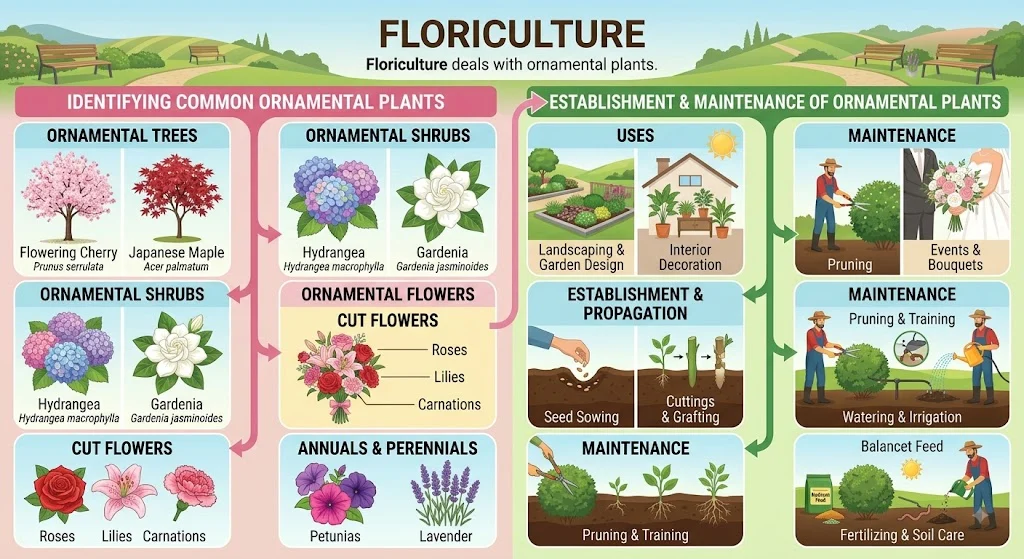
Floriculture deals with ornamental plants.
You should learn to identify common ornamental trees, shrubs, and flowers. You should also understand how these plants are established, maintained, and used.
12. Weeds
Weeds can compete with crops, so you should understand their effects on agricultural production.
Study the morphology, reproduction, dispersal, and effects of weeds.
You should also know different weed control methods, including:
- Weeding
- Mulching
- Cover cropping
- Tillage
- Herbicides
- Trap cropping
The syllabus expects you to identify weeds by their common and scientific names and classify them according to their methods of dispersal.
13. Crop Diseases
You should know how to identify organisms that cause crop diseases in both the field and stores.
The syllabus includes diseases caused by:
- Fungi
- Bacteria
- Nematodes
- Viruses
You should understand the damage these organisms cause, their symptoms, how they spread, and common methods of control.
You should also know that some disease control methods can have side effects such as pollution, poisoning, and damage to the ecosystem.
14. Crop Pests
Crop pests are also part of the Agronomy section.
You should study field and store pests, their types, economic importance, prevention, and control.
The syllabus specifically includes the life cycles of:
- Biting insects such as grasshoppers
- Boring insects such as weevils
- Sucking insects such as aphids and cotton strainers
You should also know common pesticides and their side effects.
15. Forest Management
Forest management, also called silviculture, is another topic in this section.
You should understand the importance of forests as sources of wood, pulp, fibre, and other forest products.
You should also study forest conservation methods such as:
- Regulation
- Exploitation
- Regeneration
- Afforestation
- Agro-forestry
- Taungya system
16. Crop Improvement
The final topic under Agronomy is crop improvement.
You should know why farmers improve crops and understand the different methods listed in the syllabus.
These include:
- Introduction
- Selection
- Crossing
- Quarantine
When you study crop improvement, focus on why each method is used and how the methods differ.
Section C: Animal Production
The third part of the JAMB Area of Concentration for Agriculture 2027/2028 is Animal Production. This section focuses on farm animals, their body systems, reproduction, feeding, management, diseases, fisheries, wildlife, bee-keeping, and animal improvement.
1. Forms and Classification of Major Farm Animals
You should start by learning the major farm animals found in West Africa. The syllabus covers cattle, sheep, goats, pigs, rabbits, and poultry.
You should know their:
- Species
- Breeds
- Distribution
- External features
The aim is not just to know the names of these animals. You should be able to identify their characteristics and know where different breeds are found.
Ask yourself: If you see a farm animal, can you identify it from its external features? Can you tell one breed from another?
These are the kinds of things you should understand when studying this topic.
2. General Terms in Animal Production
Animal Production has many special terms. You should know the meaning and correct use of common terms used in animal husbandry.
Examples listed in the syllabus include:
- Calving
- Kidding
- Castrate
- Capon
- Veal
- Mutton
Learn what each term means and the animal or situation it relates to. This makes it easier to understand other Animal Production topics.
3. Anatomy and Physiology of Farm Animals
This topic deals with the body of farm animals and how their body parts work.
You should study the functions of different tissues and organs in farm animals.
You should also study the major body systems, including:
- Digestive system
- Reproductive system
- Respiratory system
- Urinary or excretory system
- Nervous system
The syllabus specifically expects you to compare the digestive systems of ruminants and non-ruminants.
You should also understand how environmental changes can affect farm animals. Climate change and other environmental changes can affect the physiological development of farm animals, so this is an area you should not skip.
4. Reproduction in Farm Animals
Reproduction is another major part of Animal Production.
You should study:
- Gametogenesis
- Oestrus cycle
- Signs of heat
- Heat periods
- Secondary sexual characters
- Gestation periods
- Parturition
- Hormones involved in reproduction
You should understand what happens during reproduction and the role hormones play.
For example, you should know how signs of heat help farmers identify the right time for breeding.
Development and Birth of the Young
You should also study the development of young animals from fertilization until birth.
The syllabus includes the development, nourishment, and birth of the young, as well as mammary glands and lactation.
You should understand how the young animal develops and how it receives nourishment.
Egg Formation and Incubation
For poultry, you should study egg formation, incubation, and hatching.
Think about this question: What happens between the formation of an egg and the hatching of a chick?
You should be able to explain the stages covered in the syllabus.
5. Animal Nutrition
Animals need food to grow, stay healthy, reproduce, and produce useful products. This is why animal nutrition is an important part of the syllabus.
You should study the different feed nutrients, their sources, and their functions.
You should also learn about different types of animal feeds and how feeds are formulated.
The syllabus includes common pasture and forage crops such as:
- Guinea grass
- Elephant grass
- Giant star grass
- Andropogon species
- Calopogonium species
It also includes hay and silage preparation.
Types of Rations
You should understand different types of rations, especially:
Maintenance ration: A ration given to meet the animal’s basic needs and maintain its body.
Production ration: A ration used to support production such as growth or other productive activities.
You should also study balanced rations and simple ration formulation.
Nutrient Deficiencies
Animals can develop problems when their diets do not contain the nutrients they need.
You should learn the causes and symptoms of malnutrition and nutrient deficiencies in farm animals. You should also know the appropriate ways of correcting these problems.
6. Livestock Management
Livestock management covers how farmers care for animals from birth to slaughter.
The syllabus includes:
- Housing
- Feeding
- Sanitation
- Veterinary care
You should study these practices for ruminants, pigs, rabbits, and poultry.
You should also understand the three management systems listed in the syllabus:
- Intensive system
- Semi-intensive system
- Extensive system
Ask yourself: Why would a farmer choose one management system instead of another?
You should know the features and uses of each system.
7. Animal Health
Animal health covers diseases and parasites that affect farm animals.
Animal Diseases
You should study environmental factors that make animals more likely to develop diseases.
You should also learn about:
- Causal organisms
- Symptoms
- Transmission
- Effects
- Prevention
- Treatment
The syllabus includes diseases caused by viruses, bacteria, fungi, and protozoa.
Do not memorize disease names alone. Learn the cause, symptoms, method of transmission, and prevention or treatment method listed for each disease.
Parasites
You should also study livestock parasites.
The syllabus covers:
- Endoparasites
- Ectoparasites
- Disease vectors
You should understand their life cycles and economic importance. You should also be able to trace the life cycle of parasites from the egg stage to the adult stage.
8. Prevention and Control of Parasites
The syllabus lists several methods used to prevent and control livestock parasites.
These include:
- Dipping
- Spraying
- Deworming
- Sanitation
You should understand how each method is used and the type of parasite or problem it helps control.
9. Fisheries and Wildlife
Fisheries is another important topic under Animal Production.
You should study common fish found in West Africa, including Tilapia and Catfish.
You should also understand different fish culture systems.
Fish Farming Systems
The syllabus includes three main systems:
Extensive system: This includes inland and deep-sea fishing, as well as fishing in lakes and rivers.
Semi-intensive system: Dams are included in this category in the syllabus.
Intensive system: Fish ponds are used. You should study factors to consider when establishing and managing ponds, including pond fertilization, liming, and desilting.
Fish Harvesting and Processing
You should know different ways of catching fish, such as:
- Drag nets
- Hook and line
You should also study fish processing and preservation methods such as:
- Curing
- Sun-drying
- Smoking
Fishery regulations in Nigeria are also part of the syllabus, so do not leave this topic out.
Wildlife Management
Wildlife management covers habitat conservation, feeding, domestication, harvesting, processing, and wildlife regulations.
You should also know animals found in West African game reserves and understand why game reserves are established.
10. Bee-Keeping
Bee-keeping, also called apiculture, is the final major topic before animal improvement.
You should understand the meaning and importance of bee-keeping and its contribution to economic development.
The syllabus includes different types of bees, including exotic and indigenous bees.
You should also study different methods of bee-keeping, including:
- Traditional bee-keeping
- Modern bee-keeping
You should know common bee-keeping equipment and their uses. Safety measures are also included in this topic.
11. Animal Improvement
The final topic in Section C is Animal Improvement.
You should understand why farmers improve animals and know the methods used.
The syllabus includes:
- Introduction
- Breeding
- Quarantine
- Selection
You should also study different breeding systems, including:
- Inbreeding
- Line-breeding
- Cross-breeding
- Artificial insemination
Pay attention to the differences between these breeding systems and why each one is used.
What You Should Focus on in Animal Production
When reading this section, try to connect each topic to real farm activities.
For example, don’t just learn the word “ration”. Ask yourself what an animal needs to eat and why the farmer chooses a particular feed.
Don’t just memorize “dipping” or “deworming”. Understand what each method is used for.
This approach will help you understand the objectives in the Agriculture syllabus instead of simply memorizing words.
Section D: Agricultural Economics and Extension
The fourth part of the JAMB Area of Concentration for Agriculture 2027/2028 is Agricultural Economics and Extension. This section teaches you how Agriculture works as a business and how farmers can manage resources, labour, money, farm records, marketing, and agricultural information.
1. Factors of Agricultural Production
You should first understand the main factors needed for agricultural production.
The syllabus lists four major factors:
- Land
- Labour
- Capital
- Management
Land
You should understand what land means in Agriculture and know its uses.
You should also study the different types of land ownership in West Africa. Pay attention to how land ownership can affect agricultural production and land use.
Ask yourself: If a farmer does not have secure access to farmland, how can that affect farming?
You should be able to explain the different forms of land ownership and their effects on Agriculture.
Labour
Labour refers to the human effort used in agricultural production.
You should study the different types and sources of labour and understand how labour affects farm production.
Capital
Capital is also needed for agricultural production. You should study the different sources of capital and the problems farmers may face when trying to get capital.
Management
You should understand the role of a farm manager in an agricultural enterprise.
A good farm manager has to make decisions about resources, labour, production, and other farm activities.
The main thing to remember is that land, labour, capital, and management work together in agricultural production.
2. Basic Economic Principles
This topic introduces you to basic economic ideas that apply to Agriculture.
You should study demand and supply and understand the relationship between them in agricultural production.
You should also learn how demand and supply can be represented graphically.
Ask yourself: What happens when many people want a farm product but only a small quantity is available?
Questions like this can help you understand the relationship between demand and supply.
Production Function
You should also study production functions and the relationship between inputs and outputs.
The syllabus includes:
- Input/input relationship
- Output/output relationship
- Input/output relationship
- Stages of production
- Diminishing returns
- Scale of preference
- Choice
You should be able to relate input to output and understand economic concepts from graphs.
Pay attention to simple calculations and graphical questions in this area.
3. Characteristics of Agricultural Production
Agricultural production has some special features that make it different from many other types of production.
The syllabus includes:
- Smallness of farm holdings
- Biological limits of farm production
- Susceptibility of farm production to climate
- Seasonality of farm production
- Price elasticity in demand and supply of agricultural produce
You should understand each of these features and know how they can affect farmers and agricultural products.
For example, farming can depend heavily on seasons and climate. A farmer cannot treat crop production exactly like factory production because crops and animals are biological.
4. Labour Management
Labour management deals with how farm workers are managed.
You should study labour relations, including supervision.
You should also know different types of labour, such as permanent labour, and understand their features.
The syllabus also includes national labour laws and regulations.
The key question here is simple: How can a farm manager get workers to perform their duties properly and efficiently?
5. Farm Management
Farm management is an important area of Agricultural Economics.
You should study the qualities, functions, and problems of a farm manager.
You should also learn about farm records and why farmers keep them.
Farm Records
The syllabus includes different types of farm records, including:
- Livestock records
- Profit and loss account book
You should know why these records are important.
Imagine you run a small poultry farm but never write down how much you spend or how much you earn. At the end of the year, how would you know whether the farm made a profit?
Farm records help the farmer keep track of what happens on the farm.
Stock Evaluation
You should also study:
- Gross profit
- Net profit
- Appreciation
- Depreciation
- Salvage value
The syllabus expects you to be able to determine these values in farm management.
6. Agricultural Insurance
Agricultural insurance protects farmers against certain risks connected with agricultural production.
You should study the:
- Meaning of agricultural insurance
- Importance of agricultural insurance
- Types of agricultural insurance
- Problems of agricultural insurance
You should also understand how to determine an appropriate agricultural insurance scheme.
Ask yourself: What could happen to a farmer’s investment if something goes wrong during production?
Understanding this question will help you see why agricultural insurance is included in the syllabus.
7. Marketing of Agricultural Produce
Agricultural marketing deals with how farm products move from producers to consumers.
You should first understand the importance of marketing.
You should also study different marketing channels and the agents involved in moving agricultural products.
The syllabus expects you to classify marketing agents and explain their functions.
Problems of Agricultural Marketing
You should also understand how marketing channels can create problems for agricultural production.
For example, agricultural products may pass through different stages before reaching the final consumer. You should study the characteristics of agricultural products that can affect how they are marketed.
8. Agricultural Extension
The final topic in Section D is Agricultural Extension.
You should understand the meaning and importance of agricultural extension.
Agricultural extension helps provide farmers with useful agricultural knowledge and information.
The syllabus includes the roles of:
- Agricultural Development Programmes
- Universities
- Research institutes
- Farmers’ organizations
- Cooperative societies
You should understand how these groups support agricultural extension education.
Extension Methods
You should study the different methods used to pass agricultural information to farmers.
The syllabus specifically mentions:
- Demonstration plots
- Visual aids
- Mass media
You should be able to differentiate between these methods and understand how they are used.
Problems of Agricultural Extension
You should also study the problems affecting agricultural extension in West Africa.
The syllabus expects you to examine these problems and suggest possible solutions.
Don’t only memorize the problems. Try to understand why each problem can make it difficult for farmers to receive useful agricultural information.
What You Should Focus on in Agricultural Economics and Extension
This section contains several areas where you may need to understand relationships and perform simple calculations.
Pay special attention to:
Demand and supply, production functions, diminishing returns, elasticity, farm records, gross and net profit, appreciation, depreciation, and salvage value.
Also make sure you understand the basic meaning of land, labour, capital, and management.
Section E: Agricultural Technology
The fifth and final section of the JAMB Area of Concentration for Agriculture 2027/2028 is Agricultural Technology. This section covers farm surveying, farm tools, machinery, mechanization, processing, storage, biotechnology, ICT, and agricultural research and statistics.
1. Farm Surveying and Farmstead Planning
You should begin by understanding the meaning and importance of farm surveying.
Farm surveying is included because farmers need to understand the land they are working on. You should study common surveying equipment, their uses, and how to care for them.
You should also learn the common methods of surveying and the basic principles used in farmstead planning.
The syllabus expects you to be able to:
- Identify common surveying equipment
- Explain their uses
- Explain how to care for them
- Differentiate between common survey methods
- Apply survey principles to farmstead layout
Do not only memorize the names of surveying equipment. Learn what each one is used for and how it should be cared for.
2. Simple Farm Tools
Farmers use simple tools for different farm activities.
You should study common simple farm tools and know their uses.
You should also learn how to maintain these tools and understand their advantages and disadvantages.
Ask yourself: Why would a farmer choose a particular tool for a particular farm job?
Knowing the answer will help you understand this topic better.
3. Farm Machinery and Implements
This topic focuses on machines and implements used in Agriculture.
The syllabus includes machinery such as tractors and milking machines and also covers farm implements.
You should know common farm machinery and implements and be able to classify them according to their uses.
Uses and Maintenance
You should study how farm machines and implements are used and maintained.
The syllabus expects you to know appropriate maintenance routines and how farm machines and implements are operated.
A machine can make farm work easier, but poor maintenance can reduce its usefulness. So, pay attention to both the uses and maintenance of farm machinery.
4. Mechanization and Sources of Farm Power
Agricultural mechanization is another important topic.
You should study different sources of farm power, including:
- Animal power
- Machine power
You should understand the advantages and disadvantages of different sources of farm power and their uses in Agriculture.
You should also study the advantages and disadvantages of agricultural mechanization.
Problems and Prospects of Mechanized Agriculture
The syllabus also expects you to assess the problems and prospects of mechanized Agriculture in West Africa.
Think about a farmer who wants to use machines but has limited access to money, fuel, spare parts, or trained operators. These are the kinds of issues you should understand when studying this topic.
5. Processing and Storage
Agricultural products often need to be processed before they are used or sold.
You should study the importance of agricultural processing and understand both traditional and modern methods of food processing.
The syllabus gives examples such as:
- Gari processing
- Rice processing
- Groundnut processing
You should be able to differentiate between different processing methods.
Storage
You should also study different methods of storing agricultural produce.
The syllabus expects you to compare storage methods and apply suitable methods to agricultural products.
When studying storage, always think about the product being stored and the method that can help keep it in good condition.
6. Introduction to Biotechnology
Biotechnology is also included in the Agricultural Technology section.
You should understand basic biotechnology terms listed in the syllabus, including:
- Tissue culture
- Anther culture
- In vitro fertilization
- Genetic engineering
You should also understand why biotechnology is important and how it can be applied in Agriculture.
The important thing is to understand the basic meaning of these terms and their agricultural applications.
7. Application of ICT in Agriculture
Information and communication technology is another topic you should study.
You should know the basic features of computers and how computers can be used to support agricultural activities.
The syllabus gives examples such as:
- Disease forecasting
- Weather forecasting
- Ration formulation
- Database studies
- Simulation studies
You should understand how these computer applications can help farmers and other agricultural workers.
Communication Gadgets
You should also study the use of communication gadgets such as mobile phones and the internet in Agriculture.
Think about a farmer who needs information about weather conditions. How can a mobile phone or internet connection help?
This is the kind of practical connection you should make while studying ICT in Agriculture.
8. Introduction to Agricultural Research and Statistics
The final topic in the entire JAMB Area of Concentration for Agriculture is agricultural research and statistics.
You should first learn basic ideas used when planning agricultural experiments.
The syllabus includes:
- Hypothesis
- Treatment
- Control
You should understand the meaning and use of these terms in agricultural experiments.
Interpretation of Results
You should also learn how agricultural experiment results are interpreted.
The syllabus specifically mentions measures of central tendency and experimental errors.
You should be able to:
- Draw simple conclusions from experimental results
- Compute simple measures of central tendency
This means you should not skip the calculation part of Agricultural Technology.
What You Should Focus on in Agricultural Technology
As you study this final section, pay close attention to the objectives attached to each topic.
Focus on understanding:
Farm surveying, simple farm tools, farm machinery, mechanization, farm power, processing, storage, biotechnology, ICT, agricultural experiments, and simple statistics.
You should also practise the simple calculations mentioned in the syllabus, especially those connected with agricultural research and statistics.
That completes Section E; Agricultural Technology, the fifth and final section of the Agriculture syllabus.
The Five Main Sections at a Glance
| Section | Main Area |
|---|---|
| A | General Agriculture |
| B | Agronomy |
| C | Animal Production |
| D | Agricultural Economics and Extension |
| E | Agricultural Technology |
Important Areas to Study for JAMB Agriculture 2027/2028
Now that you have gone through all five sections, let me point out the areas you should pay close attention to. The syllabus does not only tell you the topics to read; it also tells you what you should be able to do with the knowledge.
1. Focus on Soil and Crop Production
Agronomy contains many topics, so you should give enough attention to soil and crop production.
Study soil formation, soil profile, soil texture, soil structure, soil pH, soil water, soil conservation, soil fertility, and nutrient deficiencies.
You should also understand crop propagation, seed viability, seed germination, cropping systems, planting patterns, and plant density.
Do not just memorize definitions. Try to understand how each topic applies to real farming.
2. Pay Attention to Genetics
Genetics is another area where you need to understand what you are studying.
The syllabus includes Mendel’s first and second laws, cell division, locus, alleles, genotype, dominance, homozygous and heterozygous traits, genetic crosses, and simple probability ratios.
So, I will advise you to practise the simple genetic crosses and probability questions instead of only reading the notes.
3. Study Crop Pests, Diseases and Weeds
You should know the different crop pests and diseases listed in the syllabus.
For diseases, learn the organisms that cause them, their symptoms, how they spread, the damage they cause, and their control methods.
For pests, study their types, importance, life cycles, prevention, and control.
You should also understand weed reproduction, dispersal, effects, and control methods.
4. Take Animal Nutrition and Health Seriously
In Animal Production, pay attention to feed nutrients, feed sources, balanced rations, maintenance ration, production ration, hay, silage, and nutrient deficiencies.
You should also study animal diseases, parasites, symptoms, transmission, prevention, and control.
When reading Animal Production, always ask yourself what the farmer needs to know to keep the animal healthy and productive.
5. Practise Agricultural Economics Calculations
Some Agriculture topics require simple calculations.
The syllabus includes areas such as production functions, diminishing returns, elasticity, gross profit, net profit, appreciation, depreciation, salvage value, and measures of central tendency.
Don’t wait until the examination before practising these areas.
6. Do Not Skip Agricultural Technology
Agricultural Technology covers farm surveying, farm tools, machinery, mechanization, processing, storage, biotechnology, ICT, and agricultural research and statistics.
You should know the uses of farm tools and machinery and understand their maintenance.
You should also study the basic terms used in biotechnology and agricultural experiments.
Read Also: JAMB Recommended Textbooks for Agricultural Science 2027/2028 Full List
How to Use the JAMB Area of Concentration for Agriculture
Read the Topic and Its Objectives
One mistake you should avoid is reading only the topic headings.
Look at the objectives under each topic. The objectives tell you what you should be able to do after studying that topic.
For example, the syllabus may ask you to identify, classify, differentiate, compare, calculate, apply, or evaluate something.
These words are useful because they show the level of understanding you should have.
Make Short Notes
As you study, make short notes in your own words.
For example, when studying soil conservation, don’t write many pages if you can explain the idea clearly in a few simple points.
You can write the meaning, causes, effects, and control methods. Then test yourself without looking at your notes.
Practise What You Learn
Suppose you study plant density today. Don’t stop after reading the definition.
Try some simple questions that require you to calculate plant density per hectare because the syllabus specifically expects you to be able to do this.
The same idea applies to genetics, agricultural economics, farm records, and statistics.
Revise All Five Sections
Don’t spend all your study time on one section.
The Agriculture syllabus has five sections:
- General Agriculture
- Agronomy
- Animal Production
- Agricultural Economics and Extension
- Agricultural Technology
Your revision should cover all five sections.
Frequently Asked Questions About JAMB Area of Concentration for Agriculture
1. What are the five sections in the JAMB Agriculture syllabus?
The five sections are General Agriculture, Agronomy, Animal Production, Agricultural Economics and Extension, and Agricultural Technology.
2. Does the Agriculture syllabus include calculations?
Yes. The syllabus includes simple calculations in areas such as genetic probability, plant density, elasticity, farm profit, appreciation, depreciation, salvage value, and measures of central tendency.
So, don’t treat Agriculture as a subject that requires only memorization.
3. What crop topics should I study?
The syllabus covers crop production in detail. You should study crop groups such as cereals, legumes, tubers, vegetables and spices, fruits, beverages, oils, latex, fibres, and sugars.
You should also study their propagation, husbandry, harvesting, processing, storage, pests, diseases, and economic importance.
4. Does Animal Production include fish and bees?
Yes. Animal Production includes fisheries and wildlife as well as bee-keeping or apiculture.
You should study fish culture systems, fish harvesting and processing, wildlife management, types of bees, bee-keeping methods, equipment, and safety measures.
5. Should I study Agricultural Technology too?
Yes, you should study it. Agricultural Technology is one of the five sections in the syllabus.
It includes farm surveying, simple farm tools, farm machinery, mechanization, processing and storage, biotechnology, ICT in Agriculture, and agricultural research and statistics.
Conclusion
The JAMB Area of Concentration for Agriculture covers a wide range of topics, but you can make your study easier by taking them one section at a time.
Start with General Agriculture, then move to Agronomy, Animal Production, Agricultural Economics and Extension, and Agricultural Technology.
Don’t just memorize the topic names. Study the objectives, understand the ideas, and practise the calculations and applications included in the syllabus.
I also want you to remember that this syllabus is your study guide. Use it to check what you have covered and what you still need to study.
If this JAMB Area of Concentration for Agriculture 2027/2028 guide helps you, share it with another Agriculture student. You can also leave a comment and tell me which Agriculture topic you want explained next.